This is an open-ended blog ranging from news about my latest gigs and publications
to ruminations about politics, world affairs, culture and whatever piques my interest—or ire.
Contact: tomsancton@yahoo.com
Showing posts with label French politics. Show all posts

Saturday, July 15, 2017

NEW ORLEANS MAGAZINE INTERVIEW

Interview from July 2017 edition of New Orleans Magazine


Tom Sancton
Writer, Jazz Musician

by Jason Berry


Greg Miles photograph © 2017
Tom Sancton grew up in New Orleans in the 1960s, and in high school learned jazz clarinet from George Lewis and other musicians at Preservation Hall. In fall 1967 he entered Harvard as a freshman; four years later he won a Rhodes Scholarship to Oxford University. He became a journalist, based for many years in Paris as Time’s bureau chief.

In 1997, Sancton covered the automobile accident in which Princess Diana was killed. He and a Time colleague, Scott MacLeod, wrote a best-seller, Death of a Princess. He left Time to write other books and work as a freelance.

Like many people changed by Hurricane Katrina, Sancton was pulled back to New Orleans to assist his aging parents; he ended up staying, revitalizing his jazz career, recording with Lars Edgran and others. In 2006 he published Song for my Fathers, a memoir of the complex relationship with his father, and his years of learning at Preservation Hall. “A newly minted classic,” wrote Susan Larson in the Times-Picayune, “filled with grace and gratitude.” For several years he taught writing at Tulane. His wife, Sylvaine Sancton, is an accomplished artist.

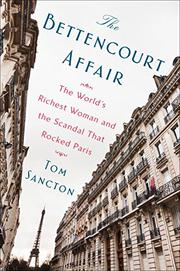
Sancton’s new book appears in August. The Bettencourt Affair follows the saga of Liliane Bettencourt, 94, heiress to the L’Oreal cosmetics fortune and he world’s wealthiest woman. Her daughter, Françoise Bettencourt Meyers, sued to gain control of the wealth after Liliane showered huge sums on François-Marie Banier, a writer-photographer and much younger gay man whom she adored. The legal actions exposed a seamy world of money-grubbing French politicians.

How did you get into this story? In 2010 there was a media feeding frenzy in Paris over “the Bettencourt Affair.” It was such a rich story with family drama and this flamboyant character in Banier. Liliane gave him hundreds of millions of dollars. Her daughter got fed up and sued him for elder abuse.

In the French system, magistrates investigate and decide whether to send a case to trial. The media coverage had a political subplot. President Nicolas Sarkozy was accused of getting illegal campaign funds from the Bettencourt fortune, which prompted comparisons to Watergate. Sarkozy lost a reelection bid.

All this was bubbling up in 2010 when I wrote a piece on the case for Vanity Fair. It took five years to wend through the justice system. In 2015, my literary agent suggested a book. I stupidly said “eighteen months” when asked about a delivery date. Writing 100,000 words is one thing. I had to do an incredible amount of reading, archival research and more than 60 interviews.

After many years in France, did you learn anything new about the country? The lingering aftershocks of World War II still ripple through French society. Liliane’s father was a Nazi collaborator in the war and created a huge fortune building L’Oréal. A deep fault line in French society runs between collaborators and the Resistance. What I learned in doing the book re-enforced that. The family fortune financed the career of André Bettencourt, Liliane’s husband, a mediocre man who donated huge sums to candidates and parties over many decades. He was  given cabinet positions in several conservative governments, decorated with the Legion of Honor, yet he wrote horrible anti-semitic diatribes for a pro-German paper during the war.  

And finally, there was the extravagance of characters like Banier -- he was one of the beautiful people close to Salvador Dali, President François Mitterrand, and more recently Johny Depp. He collected people and they collected him. He’s like the character of Balzac’s Comédie Humaine, Eugène de Rastignac, a quintessential social striver from the provinces, ruthlessly ambitious who decides he’s going to take over Paris, be the darling of society.

Banier had done three best selling novels by age 25. I don’t want to give away the ending, but he was very accessible to me. Liliane was very rich but unfulfilled and bored when he arrived in 1987 for a magazine photo shoot. She fell for him and he saw the advantage of a platonic affiar. He did have affection for her. He opened the world of arts, theatre, and auction houses to Liliane, introduced her to fascinating people, gave her a new lease on life when she was tremendously depressed. Under the guise of patronage, she gave him a collossal fortune.

Do you see parallels with Tom Benson, being sued by his adult children and grandchildren?

The Bettencourt Affair is an example of a common phonemenon in our societies. Elderly people who at some point seem to be losing discrenment, and questions revolve around the fortune and the companies they own, for their succession, and relationships with their family members. The court case was launched by the daughter, Françoise, who had a horrible relationship with her mother and was jealous of the affections Banier enjoyed. But questions about the competence of powerful, wealthy people are raised. In such cases, members of the family are trying to prove the incompetence of the matriarch or the patriarch, as one sees in Benson.

Friday, June 23, 2017

Starred Review on Booklist!


The beat goes on...

THE BETTENCOURT AFFAIR just received this nice review on Booklist. I love the last line about the French wine cellars!


BOOKLIST
Issue: July 1, 2017
Advanced Review 

The Bettencourt Affair: The World's Richest Woman and the Scandal That Rocked Paris.
Sancton, Tom (Author)
Publication date: August 8, 2017. 416 p. Dutton, hardcover, $28. (9781101984475). 338.7.


Veteran journalist Sancton chronicles the thorny saga of L’Oréal heiress Liliane Bettencourt, her mind-boggling fortune (think stock dividends averaging more than $1 million a day), and a proportionately epic family embroilment. A daughter lacking affection from a father she adored, Liliane matured into a lonely, bored wife and mother despite endless riches and responsibilities at L’Oréal. Enter Banier, an exuberant, nonconforming artist, who offers vivacity and intrigue in spades. Eventually, Liliane will bestow gifts in excess of $1 billion on Banier while the relationship with her only child, Françoise, hardens like the obdurate heart both accuse the other of possessing. Convinced he’s conning Liliane out of her own inheritance, Françoise sues Banier, and high-court drama ensues (not to mention Nazi collaboration, political high jinks involving then-president Nicolas Sarkozy, suicide, and Swiss bank accounts). Although this tale seems destined for HBO or Hollywood, to bill this a mere “family drama” belies the staggering depth with which Sancton portrays his subjects, whose motivations, desires, and downfalls are “so difficult to judge according to a moral code based on right and wrong, black and white, good and evil.” A natural for book clubs, which will drain a French cellar’s worth of wine while appreciating Sancton’s meticulous research and discussing this unbelievable cast of characters.
                                                                                                                  — Katharine Uhrich 

Monday, May 29, 2017

KIRKUS REVIEW OF MY NEW BOOK


THE BETTENCOURT AFFAIR

The World's Richest Woman and the Scandal that Rocked Paris
BUY NOW FROM


                            THE BETTENCOURT AFFAIR by Tom SanctonA juicy chronicle of France’s richest scandal.

As the daughter of L’Oréal founder Eugène Schueller, Liliane Bettencourt (b. 1922) is the wealthiest woman in the world—wealthy enough, in fact, to have lost nearly 25 million euros in Bernie Madoff’s scheme. While former Time Paris bureau chief Sancton (Song for My Fathers, 2010, etc.) tells the story of Bettencourt’s daughter’s suit against Liliane’s dear friend François-Marie Banier, he also provides an eye-opening look into the French judicial system. Based on Napoleonic code, it is a system that seems made to delay final decisions as cases wend their ways through the different court systems. Françoise Meyers brought the case against Banier for abus de faiblesse, or exploitation of weakness, in 2007, just after the onset of Liliane’s mental confusion. Françoise was a talented author and musician but never pleased Liliane. Her mother, nearly deaf, enjoyed Banier’s company and was uncharacteristically generous to him. She financed his artistic activities and gave him real estate and financial contracts for millions, not to mention the occasional check for 100,000 or 200,000 euros. Her gifts were extremely lavish, by some estimates totaling over 1 billion euros, considerable for a woman well known as a penny pincher. Banier was already a successful artist and photographer when he met Liliane, but he was also an abused child always searching for a replacement mother. What he gave her was liberation from the formal life she led. He was handsome, quirky, and a great conversationalist. Her husband, André, was warned about her gifts, but he decreed that it was her money to do with as she pleased, a stance that echoed the attitudes of her financial advisers and notary at first. André served in successive governments, due for the most part not to talent but to small brown envelopes handed to candidates.
A well-researched, crisply written, and entertaining story of family, greed, wealth, and the complex relations among them.

Thursday, September 19, 2013

DIAMONDS ARE A GIRL'S BEST FRIEND: As Sarkozy plots a comeback, the ex-First Lady underscores his bling-bling image


The night Nicolas Sarkozy was elected in 2007, he set the tone for his presidency by holding a victory celebration at the très chic Fouquet's restaurant, attended by leading members of France's glitterati. The next day, he and his family set off on a Mediterranean cruise aboard the yacht of mega-rich businessman Vincent Bolloré. Those two events, along with Sarkozy's penchant for Rolex watches, gold neck chains and Italian designer suits, forever defined him in the popular mind as the "bling-bling" President, fascinated by the vulgar trappings of wealth and beholden to those who possessed and flaunted them.
     It didn't help matters when he exchanged his first spouse for a stunning trophy wife in the person of Carla Bruni, a Franco-Italian model and singer who proceeded to spend some $500,000 in public money to set up her personal website. Sarkozy, a centre-right politician with roots in the Gaullist movement, protested that he represented the interests of all the French, rich and poor alike, and that those who dared to harp on his celebrity frequentations and his love of expensive jewelry (not to mention the extraordinary tax advantages that he concocted for the super-rich) were guilty of character assassination and base political partisanship. The voters had their say last year and dumped their bling-bling president in favor of the bland, uninspiring François Hollande, a Socialist Party veteran who championed "le petit people" and vowed to change the style and substance of French politics.
     Undermined by an economic recession and high unemployment, Hollande sank to historic lows in the polls and will face an uphill battle for re-election in 2017. As his announced conservative challengers continue to cut one another up with petty backstabbing manoeuvres, guess who is emerging as a potential frontrunner? Nicolas Sarkozy.
   
Sarkozy has tried to tone down his bling-bling image, even changing his Rolex for a more modest watch, in an effort to broaden his appeal to ordinary French voters. So one wonders what brilliant communications advisor allowed Mrs. Sarkozy to pose in the attached ads for Bulgari (rhymes with vulgary), whose image is so brazenly out of synch with the preoccupations of most voters. Is this a secret plot hatched by Sarkozy's enemies?

Friday, July 26, 2013

EX-PRESIDENTIAL FRONTRUNNER INDICTED FOR "PIMPING"

Remember Dominique Strauss-Kahn, the former head of the International Monetary Fund who was accused of raping a maid at the New York Sofitel in May 2011? The one-time French presidential frontrunner got off the hook that time after the New York D.A. dropped charges due to unreliable testimony by the alleged victim. ("DSK" later settled a civil lawsuit brought against him by the maid for a reported $6 million.) Apparently unable to learn his lesson, Strauss-Kahn was indicted this Friday for "soliciting prostitutes" for sex-parties that he admittedly took part in at the Carlton Hotel in Lille. His attorneys predict victory and vindication in a trial that could last as long as one year. The former political superstar better hope they're right: he risks ten years in prison and a € 1.5 million fine if convicted.