This is an open-ended blog ranging from news about my latest gigs and publications
to ruminations about politics, world affairs, culture and whatever piques my interest—or ire.
Contact: tomsancton@yahoo.com

Monday, July 10, 2017

DEATH OF PRINCESS DIANA REVISITED: HOW WE GOT THE STORY


On August 31, 1997, just after midnight, a black Mercedes bearing Princess Diana and her lover Dodi Fayed struck the 13th pillar of Paris's Alma tunnel, spun around, and crashed into a concrete wall. Within minutes, I was awakened by an urgent call from TIME's news desk in New York. As the magazine's Paris Bureau Chief, I was responsible for our coverage of this stunning event.
     My fellow correspondent Scott MacLeod, who lived just across the Seine from the crash site, was already standing outside the blocked off Alma tunnel, notebook in hand, interviewing eyewitnesses even as French medics worked desperately to save Diana's life and extract her from the crumpled wreck. (It was already too late for Dodi and driver Henri Paul: both had died instantly.)
     Meanwhile, I worked the phones and followed live TV coverage from my suburban home in Le Vesinet. Like millions of people around the world, I was shocked and saddened by the news bulletin that Diana had died on an emergency room operating table at 4:00 a.m. Working well past dawn, Scott and I filed our reports to New York, caught a few hours sleep, then headed into the TIME bureau just off the Champs-Elysées to plan our continuing coverage of the event and its aftermath.
     The Diana story was our unique focus for the next three weeks, as the magazine probed the background of the accident, the role of the pursuing paparazzi, and the conspiracy theories that began to circulate almost immediately after the accident. Along with our colleagues in the U.K., and a team of writers and editors in New York, Scott and I contributed to no fewer than three successive cover stories on Diana's death. Circumstances had put us at the epicenter of this event and the reporting we accumulated over those three weeks had made us some of the most knowledgable observers outside the French police investigators.
     It was at that point that, with the encouragement of super-agent Andrew Wylie, Scott and I proposed to do a book on what was then the hottest subject in the news business. To our amazement, Andrew sold it in 14 countries within a week or so. That was the good news. The bad news was that the publishers wanted the first half of the book by the end of November and the rest by December 15. Less than two months from our signing date. We both took leaves of absence from TIME and plunged into what remains the most daunting assignment of our careers. The result was DEATH OF A PRINCESS, which became a New York Times and international bestseller.
     This year, for the 20th anniversary of Diana's tragic end, my publisher, Dutton, asked us to prepare a revised and updated edition. Again there was only a short time available for this job, but journalists live by deadlines and this one was more manageable than the week-to-week rhythm we'd had to deal with on the magazine. There was relatively little to change in the main body of the book, but bringing the story up to date meant delving into the results of the French investigation, and the subsequent British inquest, and tracing the lives of the various protagonists—Prince Charles and his sons, Mohamed al-Fayed, the paparazzi, et al.—in the years since 1997. The result is now available on Amazon and iBooks. Anyone interested in this dramatic and historic story should click on those links now: we don't plan to do a 40th anniversary edition!

To buy the e-book edition of Death of a Princess, click on the links below:

Amazon 

iBooks


Saturday, July 8, 2017

ORSON VIDEO OF SONG FOR MY FATHERS E-EDITION


Richard Mason and Benjamin Morse, creators of the Orson interactive e-edition of my book Song For My Fathers, have just posted a short video about it on youtube. It's an excellent introduction to the new world of interactive books that Orson has invented. I was thoroughly bowled over by what they and their tech people did with my book. They took it from a static print version to a multidimensional experience combining musical performances, interviews, videos, and dozens of rare photos--not to mention an audiobook track synched to the text. The Orson edition of Song for my Fathers is currently on offer for half price ($12) throughout the summer. Have a look: https://youtu.be/YwEsCFqOdFc

Friday, June 23, 2017

Starred Review on Booklist!


The beat goes on...

THE BETTENCOURT AFFAIR just received this nice review on Booklist. I love the last line about the French wine cellars!


BOOKLIST
Issue: July 1, 2017
Advanced Review 

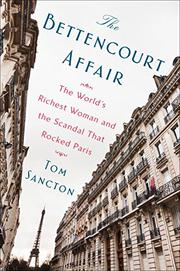
The Bettencourt Affair: The World's Richest Woman and the Scandal That Rocked Paris.
Sancton, Tom (Author)
Publication date: August 8, 2017. 416 p. Dutton, hardcover, $28. (9781101984475). 338.7.


Veteran journalist Sancton chronicles the thorny saga of L’Oréal heiress Liliane Bettencourt, her mind-boggling fortune (think stock dividends averaging more than $1 million a day), and a proportionately epic family embroilment. A daughter lacking affection from a father she adored, Liliane matured into a lonely, bored wife and mother despite endless riches and responsibilities at L’Oréal. Enter Banier, an exuberant, nonconforming artist, who offers vivacity and intrigue in spades. Eventually, Liliane will bestow gifts in excess of $1 billion on Banier while the relationship with her only child, Françoise, hardens like the obdurate heart both accuse the other of possessing. Convinced he’s conning Liliane out of her own inheritance, Françoise sues Banier, and high-court drama ensues (not to mention Nazi collaboration, political high jinks involving then-president Nicolas Sarkozy, suicide, and Swiss bank accounts). Although this tale seems destined for HBO or Hollywood, to bill this a mere “family drama” belies the staggering depth with which Sancton portrays his subjects, whose motivations, desires, and downfalls are “so difficult to judge according to a moral code based on right and wrong, black and white, good and evil.” A natural for book clubs, which will drain a French cellar’s worth of wine while appreciating Sancton’s meticulous research and discussing this unbelievable cast of characters.
                                                                                                                  — Katharine Uhrich 

Wednesday, June 14, 2017

TOMMY SANCTON'S EUROPEAN PERFORMANCE SCHEDULE 2017


June 21: Le Gramophone, 9 Grande Rue, 78160 Marly-le-Roi. With the Tommy Sancton Quartet. 8 p.m. - 11 p.m.


July 15: Le Gramophone, 9 Grande Rue, 78160 Marly-le-Roi. With the Tommy Sancton Quartet. 8 p.m. - 11 p.m. Special tribute to George Lewis.

September 3: Rendez-Vous de l'Erdre Festival, Nantes. With Claus Walkstein All Stars featuring Trevor Richards. 2:30 p.m. - 7 p.m.

October 12: Nieder-Olm / Mainz, Germany: BARRELHOUSE JAZZ GALA, Eckeshalle. With Barrelhouse Jazz Band, featuring guests Rick Trolsen, Kevin Lewis, and Brenda Boykin. 8 p.m. - 11 p.m.

October 13: Bensheim / Bergstrasse: BARRELHOUSE JAZZ GALA, Parktheater. With Barrelhouse Jazz Band, featuring guests Rick Trolsen, Kevin Lewis, and Brenda Boykin. 8 p.m. - 11 p.m.

October 14: Frankfurt: BARRELHOUSE JAZZ PARTY in the old Frankfurt Opera House. With Barrelhouse Jazz Band, featuring guests Rick Trolsen, Kevin Lewis, and Brenda Boykin. 8 p.m. - 11 p.m.

October 15: Lauda/Tauber: BARRELHOUSE JAZZ GALA, Schulzentrum. With Barrelhouse Jazz Band, featuring guests Rick Trolsen, Kevin Lewis, and Brenda Boykin. 6 p.m. - 9 p.m.


Starred Review in Library Journal!


Following up on Kirkus Reviews and Town & Country, here's a nice pre-publication review of my new book in the Library Journal: 


Judgment Day: François-Marie Banier at Bordeaux courthouse
“There is no comparable work on the Bettencourt scandal, only interviews and articles, making this highly recommended and pleasurable read a mix of luring tabloid fare and professionally researched courtroom and political drama.”

*Sancton, Tom. The Bettencourt Affair: 
The World’s Richest Woman and the Scandal That Rocked Paris. 
Dutton. 
Aug. 2017. 416p. maps. notes. 
ISBN 9781101984475. 
$28; 
ebk. ISBN 9781101984482. BIOG

Expanding upon a 2010 Vanity Fair article introducing the Bettencourt scandal to an American audience, journalist and author Sancton (Song For My Fathers) accords France’s epic family drama the book-length exposé it thoroughly deserves. As “The French Company of Inoffensive Hair Dyes,” Eugène Schueller founded what would become French beauty giant L’Oreal in 1909. A century later his daughter Liliane Bettencourt was one of the world’s wealthiest. Her friendship with eccentric younger artist François-Marie Banier, whom she showered with expensive gifts, led her daughter Françoise to open a lawsuit alleging elder abuse. What started as a family affair quickly turned into an “affair of state” that reached then President Nicolas Sarkozy with allegations of campaign finance fraud regarding donations received from the Bettencourts. With impeccable research, Sancton takes readers through Bettencourt family history, from L’Oreal’s humble beginnings and continuing to document political upheaval in France during the last century. The years of legal proceedings are presented with their subsequent unexpected impact on the French presidency. 
VERDICT There is no comparable work on the Bettencourt scandal, only interviews and articles, making this highly recommended and pleasurable read a mix of luring tabloid fare and professionally researched courtroom and political drama.—Jessica Bushore, Xenia, OH

Tuesday, June 13, 2017

TOWN & COUNTRY TOUTS BETTENCOURT AFFAIR


Happy to report that Town & Country included my new book, The Bettencourt Affair, on its hot summer reading list. Here's their blurb:


Former Time Paris bureau chief Tom Sancton follows what happened when the world’s richest woman, cosmetics heiress Liliane Bettencourt, became the center of a scandal that captivated Europe. This true story of the elderly billionaire, the artist to whom she gave a fortune, and the family that claims it’s all been a big con, is proof that truth is stranger—or at least makes better poolside reading. (Out August 8.)

BUY NOW FROM 
AMAZON

Monday, May 29, 2017

KIRKUS REVIEW OF MY NEW BOOK


THE BETTENCOURT AFFAIR

The World's Richest Woman and the Scandal that Rocked Paris
BUY NOW FROM


                            THE BETTENCOURT AFFAIR by Tom SanctonA juicy chronicle of France’s richest scandal.

As the daughter of L’Oréal founder Eugène Schueller, Liliane Bettencourt (b. 1922) is the wealthiest woman in the world—wealthy enough, in fact, to have lost nearly 25 million euros in Bernie Madoff’s scheme. While former Time Paris bureau chief Sancton (Song for My Fathers, 2010, etc.) tells the story of Bettencourt’s daughter’s suit against Liliane’s dear friend François-Marie Banier, he also provides an eye-opening look into the French judicial system. Based on Napoleonic code, it is a system that seems made to delay final decisions as cases wend their ways through the different court systems. Françoise Meyers brought the case against Banier for abus de faiblesse, or exploitation of weakness, in 2007, just after the onset of Liliane’s mental confusion. Françoise was a talented author and musician but never pleased Liliane. Her mother, nearly deaf, enjoyed Banier’s company and was uncharacteristically generous to him. She financed his artistic activities and gave him real estate and financial contracts for millions, not to mention the occasional check for 100,000 or 200,000 euros. Her gifts were extremely lavish, by some estimates totaling over 1 billion euros, considerable for a woman well known as a penny pincher. Banier was already a successful artist and photographer when he met Liliane, but he was also an abused child always searching for a replacement mother. What he gave her was liberation from the formal life she led. He was handsome, quirky, and a great conversationalist. Her husband, André, was warned about her gifts, but he decreed that it was her money to do with as she pleased, a stance that echoed the attitudes of her financial advisers and notary at first. André served in successive governments, due for the most part not to talent but to small brown envelopes handed to candidates.
A well-researched, crisply written, and entertaining story of family, greed, wealth, and the complex relations among them.

Sunday, January 24, 2016

TOM SANCTON'S PERFORMANCE SCHEDULE FEB-MAY 2018


February 24: Le Gramophone, 9 Grande Rue, 78160 Marly-le-Roi, France With pianist David Paquette. 8 p.m. - 11 p.m.

March 8: Octavia Bookstore, 513 Octavia St., New Orleans 70115. Presentation and readings from THE BETTENCOURT AFFAIR. 6 p.m.

March 25: Presbytere, 751 Charters Street, New Orleans, 70116, 2 p.m. - 4:30 p.m. Presentation and readings from THE BETTENCOURT AFFAIR, under the auspices of the Faulkner Society.

April 7: Palm Court Jazz Cafe, 1206 Decatur Street, New Orleans. With Lars Edegran band. 8 p.m. - 11p.m.

April 14: Preservation Hall, 726 St. Peter St., New Orleans. With Lars Edegran band, 1 p.m. - 1:45 p.m.

April 14: Palm Court Jazz Cafe, 1206 Decatur Street, New Orleans. With Lars Edegran band. 8 p.m. - 11p.m.

April 15: Preservation Hall, 726 St. Peter St., New Orleans. With Seva Venet String Band, 12 p.m. - 12:45 p.m.

April 15: French Quarter Festival, 600 Bourbon, with Clive Wilson's Serenaders, 3 p.m. - 4:15 p.m.

April 15: French Quarter Festival, 600 Bourbon, with New Orleans Legacy Band, 4:30 p.m. - 5:45 p.m.

April 25: Palm Court Jazz Cafe, 1206 Decatur Street, New Orleans. With Lars Edegran band. 8 p.m. - 11p.m.

April 26: Palm Court Jazz Cafe, 1206 Decatur Street, New Orleans. With Clive Wilson Serenaders featuring Butch Thompson. 8 p.m. - 11p.m.

April 27: Jazzfest, Economy Hall Tent, with Clive Wilson's Serenaders featuring Butch Thompson. Time TBA.

May 6: Jazzfest, Economy Hall Tent, with New Orleans Legacy Band featuring Jason Marsalis. Time TBA.


Tuesday, November 17, 2015

FRANCE AT WAR


The coordinated attacks that struck targets in Paris and the suburb of Saint Denis last week put France on a virtual war footing. The carnage was horrific—at least 129 dead and 352 wounded. But even more shocking than the body count was the realization that the country was now confronted with a new kind of enemy: radicalized home-grown terrorists, supported from abroad, nurtured on a cult of death, and craving the transdendence of martyrdom. Unlike the assault on Charlie Hebdo last January, these assaults—the first suicide attacks on French soil—did not focus on a single symbolic target but sought to kill as many people as possible, raining panic and fear on the whole population.
      It began at 9:20 on a chilly Friday night with a bomb blast outside the Stade de France in Saint Denis, where President François Hollande was attending a soccer match between France and Germany. Mistaken at first for fireworks, the explosion was followed by a second, then a third detonation. As security officials whisked Hollande away to safety, they received reports of coordinated attacks in Paris: heavily armed gunmen had burst into the Bataclan music hall, firing indiscriminately into the crowd of rock fans and taking the survivors hostage; other attackers raked gunfire across nearby sidewalk cafes and restaurants, leaving a sprawl of bleeding bodies in their wake. By the time French security forces stormed the Bataclan shortly after midnight, killing one assailant as two others blew themselves up with explosive belts, 89 concert-goers were dead. Four other attackers were pulverized by their suicide bombs, three outside the Stade de France and one on a Paris street corner.
     Addressing the nation late Friday night, the president promised a “pitiless” response to the worst terror attack ever carried out on French soil. “What we defend,” he said, his voice shaking with emotion, “is our country but much more than that: it is the values of humanity.” On Saturday morning, he denounced the attacks as “an act of war” organized from “outside the country with help from inside.” The presumed author: the so-called Islamic State based in Syria.
      Invoking a little used law dating back to the Algerian War, Hollande declared a state of emergency that allows authorities, at their discretion, to carry out warantless searches, impose curfews, and ban public meetings. On Monday, addressing a rare joint session of Parliament at the Chateau de Versailles, Hollande called for a three-month extension of the state of emergency, increased assets for police and justice authorities, and powers to strip French citizenship from binationals convicted of terrorism. He said he would seek broader surveillance powers and a constitutional amendment that would enable the state to take exceptional security measures. On the military front, he promised to intensify French air strikes against ISIS targets in Syria, aided by the arrival in the region next month of the aircraft carrier Charles de Gaulle. On Sunday night, French fighter-bombers aided by U.S. targeting information attacked the ISIS headquarters in Raqqa, destroying a command center and a training camp. A second French air strike followed on Monday.
      By Sunday, French police had identified six of the seven assailants killed in the assaults—including four French nationals. A car with Belgian plates found near the Bataclan put authorities on the track of the possible eighth member of the commando. The suspect, Saah Abdelsalam, is believed to have returned to Belgium but remains at large. French and Belgian authorities also launched a manhunt for Addelhamid Abaaoud, a 27-year-old Belgian and ISIS fighter believed to be the mastermind of last week’s assaults. A Syrian passport found near the body of one of the suicide bombers was traced to a man who had entered Greece last month as a refugee. The discovery raised new fears that foreign terrorists may be infiltrating the migrant flows into Europe and caused some countries, including Poland, to heighten their resistance to accepting new refugees.
      ISIS claimed responsibility for the attacks with an online communiqué whose comic-book language would be ludicrous if the subject were not so dire. It praised the “blessed attack” on the “capital of abominations and perversion, which carries the banner of the cross in Europe.” The “accurately chosen targets” included “the Stade the fool of France, François Hollande, was present” and the Bataclan music hall “where hundreds of apostates had gathered in a profligate prostitution party.” The statement closed with an ominous injunction: “This attack is just the beginning of the storm and a warning to those who want to learn its lessons.”
     The horrific events did come as a surprise. Indeed, French security experts had expected a big coordinated attack like this for months. In an interview published in Paris Match last September, Marc Trévidic, formerly the country’s top antiterrorism judge, called France “the principal target of an army of terrorists with unlimited means…and a desire, which they have expressed clearly and unceasingly, to strike us…The real war that ISIS intends to wage on our soil has not yet begun.”

Why France? Partly because France has been carrying out air strikes against ISIS targets in Iraq and Syria as part of the 10-nation U.S.-led coalition. The attackers who burst into the Bataclan shouted, “You can blame Hollande for this. He didn’t have to intervene in Syria.” But that is only part of the explanation. As the ISIS communiqué suggests, France was also targeted because of its culture and lifestyle, its commitment to a kind of secular liberty and joie de vivre that is an abomination in the eyes of the islamists. The young rock fans had nothing to do with Syria, no more than the café patrons enjoying a glass of wine and a chat with friends at their sidewalk tables. “The targets are no longer identified,” says Gilles Kepel, a specialist on Islam at the Institute of Political Studies in Paris. “The goal is to kill blindly. In their eyes, all those who live in France are Crusaders, disbelievers, or renegades. All the French are targets.”
     With its large Muslim population, France also offers a fertile breeding ground for Islamic radicalism, especialy among embittered youths in the crime-ridden, high-unemployment suburbs. According to Prime Minister Manuel Valls, more than 1500 young French Muslims have gone to fight alongside ISIS in Syria and Iraq. Those who return, thoroughly indoctrinated, battle-hardened, and endowed with military training, constitute a potential cadre of terrorist fighters on French soil. It is no longer the “lone wolf” phenomenon, but the threat of organized, coordinated operations that worries French security experts.
     France is also an attractive target in terms of the jihadists’ overall strategy of dividing European societies precisely by provoking an anti-Muslim backlash. “They see Europe as the soft underbelly,” says Kepel, “because of its economic difficulties and ethnic tensions. Their aim is to create discord in the countries of Europe in order to eventually bring about a civil war on which they can build their utopia of the caliphat.” Indeed, the Paris attacks were followed by a series of anti-Muslim incidents, including the drive-by shooting and wounding of a Turk in the northern city of Cambrai by a man who later committed suicide.
      Hollande’s calls for national unity in soon ran into partisan strains amidst a hard-fought campaign around next month’s regional elections and the looming 2017 presidential contest. Former president and probable future candidate Nicolas Sarkozy called for more “drastic security measures.” “The war that we lead must be total,” he said, recommending, among other things, house arrest and electronic bracelets for suspected radicals, expulsion of hate-spouting imams and the closing of their mosques. That was in line with the hardnosed approach of Marine Le Pen, leader of the far-right Front National, who called for permanent border controls in place of the open-door Shengen agreement, “rearmament,” and a realignment of France’s diplomacy. “France must choose between its friends and its enemies,” she said. “Its enemies are those countries who maintain friendly relations with radical islamism.” Le Pen, a leading presidential contender according to the polls, seemed poised to benefit from the heightened fears of terrorism and insecurity, two of her main themes.
       The resort to stringent security measures caused some observers, with an eye to the U.S. Patriot Act, to worry that overreaction to the attacks may in fact result in a curtailment of French liberties and a more intrusive, repressive state. “Only a love of freedom permits us to remain free,” Laurent Joffrin editorialized in the left-leaning daily Libération. “To suppress liberties and propose laws of exception is already a surrender.”
       In Paris on Sunday, under blue skies, small groups gathered around makeshift shrines of candles and flowers on the Place de la République, in front of the barricaded Bataclan, and on the sidewalks near the cafes whose shattered glass windows still bore witness to the horror. Some prayed, some cried, some joined hands and sang La Vie en Rose. Two men and a woman held signs offering free hugs. Within days, life would slowly return to normal as theaters, museums and shops reopened and people went about their business. No one knows if or when the next attack will come. But it will be a long time before Parisians will be able to enjoy a drink at a sidewalk café, shop at a crowded market, or attend a concert without thinking of the events of Friday the 13th of November.


Sunday, October 4, 2015

SONG FOR MY FATHERS --THE INTERACTIVE E-BOOK VERSION

 AT LAST! The new improved interactive e-book edition of SONG FOR MY FATHERS is now available for iPad downloads. In addition to the full text of this coming-of-age-in-New Orleans jazz memoir, there is an audio narration, some 100 vintage photos, musical performances, interviews, plus rare video footage of jazz funerals, parades, and recording sessions from the 1950s and 60s. Anyone who liked the print edition (and has an iPad) will get a real kick out of this multidimensional you-are-there version.

Here's how to get it: 1) go to Apple App store, 2) find and download "eLume" app from Orson and Co., 3) go on the app and choose SONG FOR MY FATHERS among their offerings, 4) pay and download the package--takes about 10 minutes, 5) enjoy!

For inquiries and download help: info@orsonandco.com